Table of Contents
- How Often Should Commercial Windows Be Cleaned? The Short Answer
- Commercial Window Cleaning Maintenance Schedule by Building Type
- Benefits of Professional Window Cleaning for Your Business
- Signs Your Windows Need Immediate Cleaning
- DIY vs. Professional Equipment Requirements
- Why First Impressions and Curb Appeal Drive the Decision
- Commercial Window Cleaning Cost: What Drives the Price
- Building a Service Contract That Works
- Frequently Asked Questions
Last Updated: September 17, 2026
How Often Should Commercial Windows Be Cleaned? The Short Answer
Most commercial storefronts should be cleaned every two to four weeks. At Curb Appeal Solutions, we clean windows across the Upstate.

Commercial windows cleaning frequency depends on foot traffic, pollution, weather, tree cover, and road proximity. A quiet suburban office can stretch to quarterly; a busy retail frontage on a main road needs monthly service at minimum. The U.S. General Services Administration facilities guidance treats exterior glass as routine building maintenance, not a one-off task.
There is no single right answer for every building. Match your service frequency to traffic, environment, and how much your windows shape customer perception.
Commercial Window Cleaning Maintenance Schedule by Building Type
A commercial window cleaning maintenance schedule should match the building:
| Building Type | Recommended Frequency | Main Reason |
|---|---|---|
| Retail storefront | Bi-monthly to monthly | Fingerprints and curb appeal |
| Suburban office | Quarterly | Low traffic, less grime |
| Urban high-rise | Monthly to quarterly | Pollution and grime buildup |
The more people who touch and pass your glass, the more often it needs attention: a glass storefront collects fingerprints, dust, and grime fast, and customers read dirty glass as a poorly run business.
Walk your property at eye level, not from the parking lot. Smudges and streaks that look minor from a distance are obvious up close, right where customers stand.
Benefits of Professional Window Cleaning for Your Business
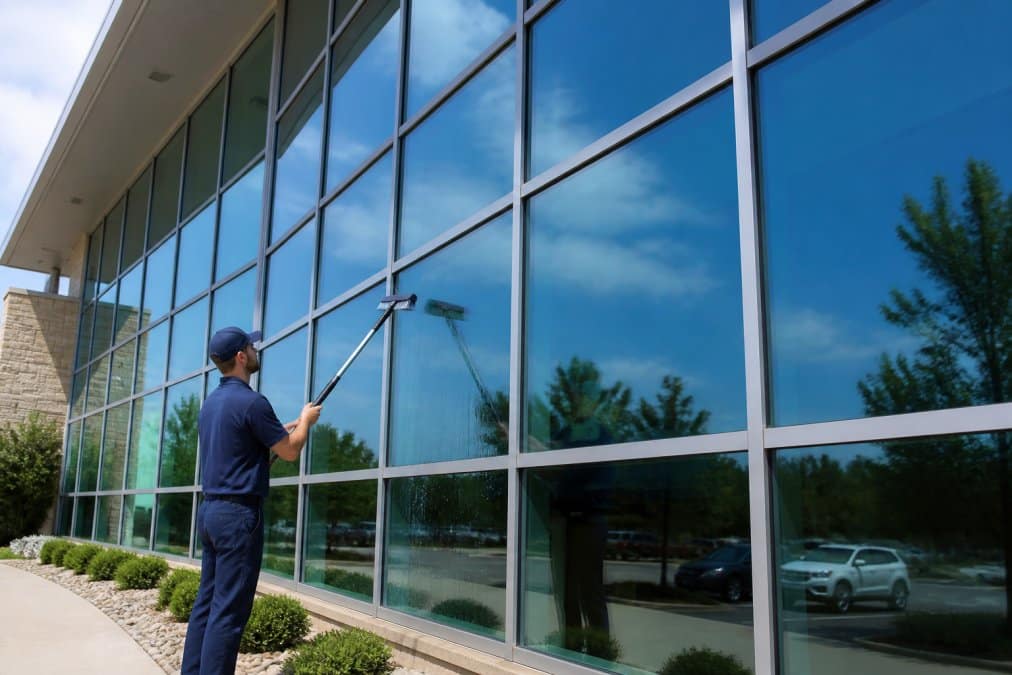
The benefits of professional window cleaning go beyond looks: stronger first impressions, longer window longevity, better natural light, and fewer costly restorations. Hard water stains and glass etching are the quiet threats: minerals bond to glass over time and etch it permanently, so prevention is the only fix. Professional window washing uses a low-pressure approach that lifts grime without harming frames, seals, or surrounding materials, and reaches high glass safely. Working at height carries real risk, and the OSHA standards for fall protection apply to anyone cleaning elevated glass; a professional crew carries the training, equipment, and insurance to do the job safely. Eco-friendly methods also avoid harsh runoff that can harm landscaping and nearby surfaces.
Skipping regular cleaning to save money usually backfires. Hard water stains and glass etching become permanent, and replacing glass costs far more than a maintenance contract ever would.
Signs Your Windows Need Immediate Cleaning
Watch for streaks or haze at eye level, fingerprints on entry doors, water spots that stay after rain, a dull film blocking light, and grime along frames and sills, any of these means your frequency is too low.
DIY vs. Professional Equipment Requirements
DIY works for a single home window but falls apart on commercial glass. Professional crews use water-fed poles, purified water systems that prevent spotting, squeegees sized for large panes, and low-pressure methods safe for seals and frames.
Why First Impressions and Curb Appeal Drive the Decision
For a retail business, the glass storefront is the first thing a customer sees. Clean glass signals a business that pays attention; dirty glass signals the opposite, and customers decide in seconds.
Commercial Window Cleaning Cost: What Drives the Price
Commercial window cleaning cost depends on building size and glass count, height and access, service frequency, and grime level. A monthly contract usually costs less per visit than one-off cleanings. Reach out to Curb Appeal Solutions for a fast quote.
Building a Service Contract That Works
A service contract turns window cleaning into a routine: count your glass, pick a base frequency, add visits for pollen and winter, confirm the crew’s insurance and safety training, and review the schedule yearly.
Property managers juggling multiple buildings who want one reliable schedule instead of chasing quotes every few months.
Frequently Asked Questions
What is the going rate for commercial window cleaning?
Commercial window cleaning cost depends on the number of panes, building height, and how much hard water staining or grime has built up. Storefronts with a handful of exterior panes cost far less than a multi-story office with interior and exterior glass. Because pricing varies by property, the most accurate approach is to request a walkthrough quote. Curb Appeal Solutions provides fast quotes based on your specific building, so you get a real number instead of a guess.
Does window cleaning frequency depend on building location?
Location matters more than most property managers expect. A storefront on a busy road collects exhaust film and dust far faster than an office set back from traffic. Buildings near trees deal with pollen and sap, while properties in high-pollution corridors see grime buildup within weeks. Urban high-rise and suburban office buildings rarely need the same schedule. Walk your property monthly and check the glass at eye level to judge whether your current frequency is keeping up.
How does regular window maintenance extend the lifespan of glass?
Glass looks permanent, but mineral deposits from hard water and irrigation spray bond to the surface over time. Left long enough, those deposits cause glass etching, a permanent cloudiness that no cleaning can reverse. Regular professional window washing removes minerals before they bond, protecting window longevity and avoiding replacement costs. Streaking and dust accumulation are cosmetic problems, but etching is structural damage. A consistent maintenance schedule is cheaper than replacing glass.